
Hull Geological Society
Geology field guides and walks
Humber Bridge Country Park and Hessle Foreshore.
Disclaimer – details
about parking and facilities may have changed since the author last visited
these sites.
Note all sites are best visited on a falling tide. For some the tide is critical either to view the site or to avoid getting stranded. You are recommended to wear a hard hat when examining cliffs.
Summary -
Conservation status -
Parking – Hessle foreshore car parks or Country Park Car park above the quarry
Facilities – toilets near the old windmill and at the upper car park
Access – if you enter from the Humber end of the site it might be suitable for wheel chairs into part of the site.
Beach – pebbles and slippery mud.
Hazards – slippery mud, brambles and quarry faces.
Safety and PPE – normal outdoor clothing, plus hard hat if you want to get close to the quarry faces.
Geological highlights – History of the Humber Gap, erratics, local water table, recolenisation of an old quarry by wildlife and
Other interests there or nearby – Humber Bridge
The Excursion -
Stop 1 - Under the Humber Bridge.
There is a large fault somewhere in the middle of the Humber which has a downthrown on the northern side (meaning that the Chalk on the South Bank is much lower in the sequence). The
Humber Fault affected the construction of the Bridge causing difficulties in the foundations of the south tower. It is also the reason that there is a gap in the chalk Wolds. The Humber Gap was blocked by a glacier to the east during the last ice age causing the formation of the large Lake Humber to the west in the Vale of York.If the tide permits you can study the pebbles on the foreshore. These are mainly pieces of Chalk with industrial waste and a few glacial erratics.
Stop 2 - the black windmill.
The mill was used to crush the chalk that was extracted from the quarry. It is open to the public for a few days each week and well worth a look around. You can check their website for opening times. Paving slabs of an interesting fossil-rich limestone have been placed around it base: these are not local and probably come from Dorset.
Stop 3 - the Humber Bridge Country Park.
Walk
through the tunnels under the main road and railway into the Country Park. Known
locally as Little Switzerland, the large disused quarry is now owned and managed
by the East Riding of Yorkshire County Council. The Chalk exposed in the former quarry is in the Welton
Formation of Turonian age and within the Terebratulina lata biozone.
Walk
further into the Country Park observe how the site was being colonised by plants and trees.
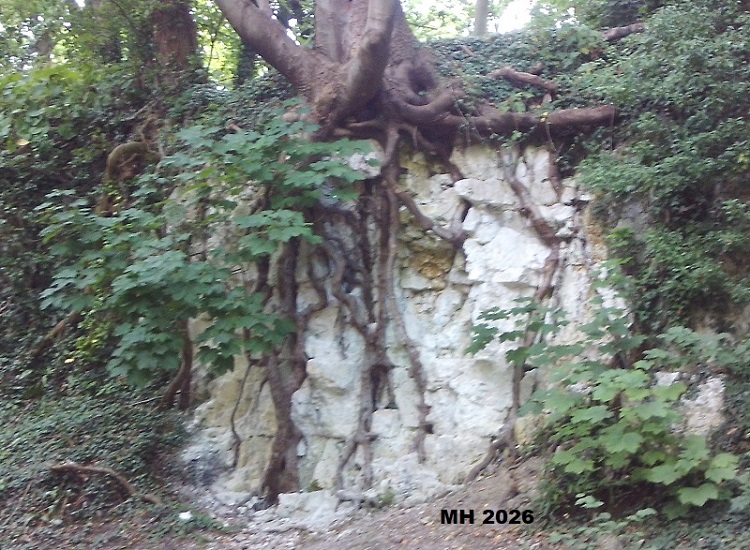
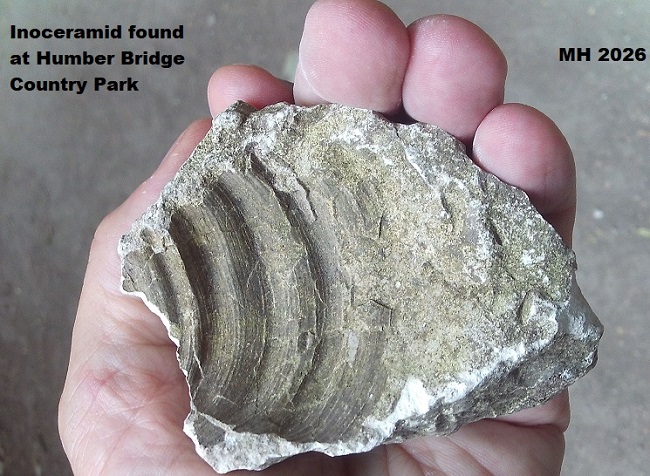
If you wander along the western exposure of the Chalk you can clearly see the flints and marl bands, in the Chalk. Fossils are rare in this part of the Chalk sequence, but if you are lucky you might find something in the scree, such as this Inoceramid bivalve.
.
Some small faults are visible in the quarry faces.
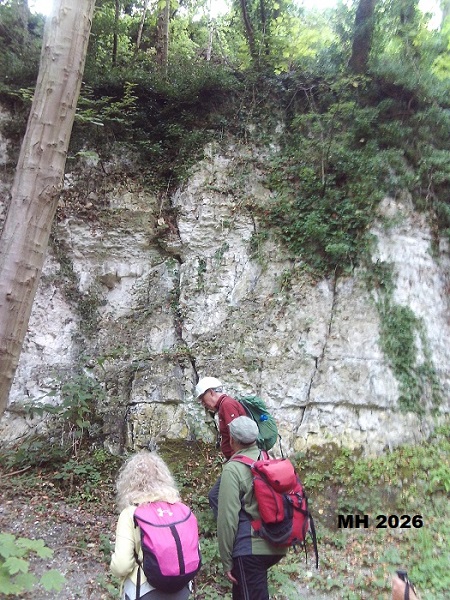
Stop 4 - the Lake
There is a large lake in the far end of the park. The lake rises and falls with the water table.The water takes on a lovely blue colour if it has not been disturbed.
Photos by Anne and Mike Horne.
Copyright - Mike Horne and Hull Geological Society 2026
Registered Educational Charity No. 229147