Humberside Geologist no 19
Report
of the field meeting held on Saturday 18th July 2026 at the Humber
Bridge Country Park, led by Mike Horne.
A group of thirteen geologists from the Rotunda Geology Group
and the Hull Geological Society gathered under the Humber Bridge. Mike told the
group about the Humber Fault and how that affected the construction of the
Bridge. He also explained how the Humber Gap was blocked by a glacier during the
last ice age causing the formation of the large Lake Humber to the west in the
Vale of York. Mary Howard related some interesting facts to the group about the
Humber Bridge and its construction with a final prize quiz question.
The next stop was the former black windmill which was used to
crush the chalk that was extracted from the quarry. The party then walked
through the tunnels under the main road and railway into the Country Park. Known
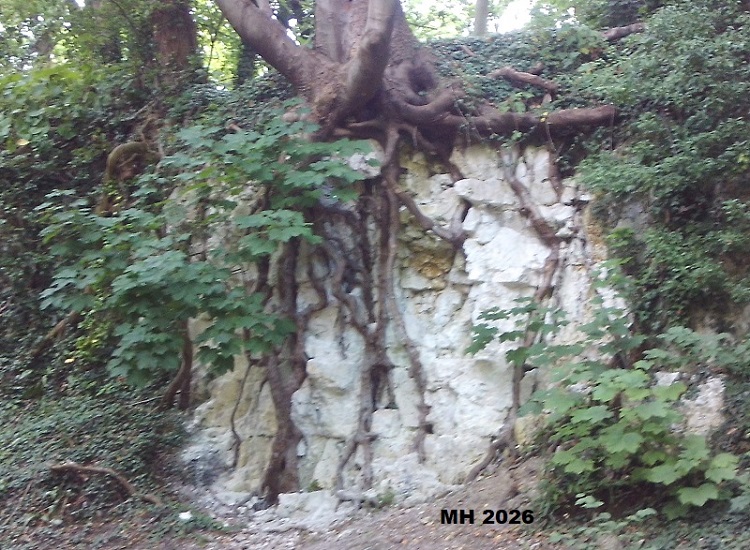
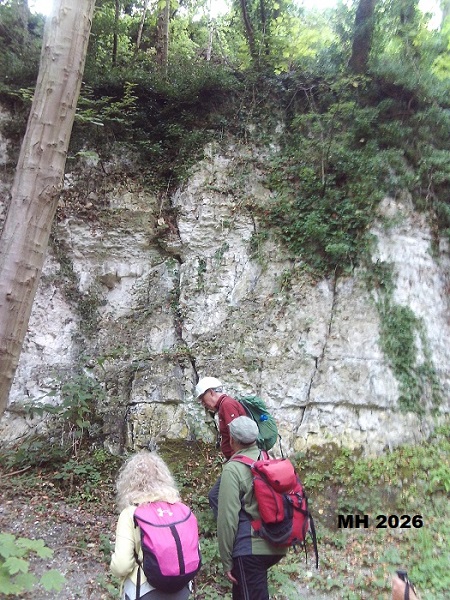
locally as Little Switzerland, the large disused quarry is now owned and managed
by the East Riding of Yorkshire County Council. Mike told the group about the
stratigraphy of the Yorkshire Chalk and where this former geological SSSI sits
in the sequence. The Chalk exposed in the former quarry is in the Welton
Formation of Turonian age and within the Terebratulina lata biozone.
The group then walked further into the Country Park observing
how the site was being colonised by plants and trees.
Lunch was taken beside the large lake in the centre of the
park. The lake rises and falls with the water table and was quite low at the
time of the visit due to the onset of the 2026 summer drought. After lunch the
group wandered along the western exposure of the Chalk looking closely at the
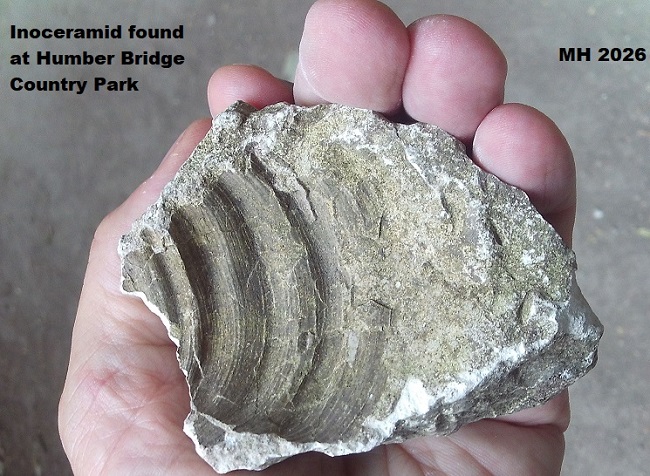
flints and marl bands. Some fossils were found including an Inoceramid bivalve
(they are not common in this part of the Chalk stratigraphic sequence).
.
The excursion finished back at the Humber Bridge with a search
of Hessle Foreshore for some glacial erratics.
Report by Mike Horne. Photos by Anne and Mike Horne.
[First submitted 29th August 2026;
published 12th September 2026]
copyright Hull Geological Society 2026