Humberside Geologist no 19
Report
of the field meeting held at Skipsea on Friday 14th August 2026,
by
Mike Horne.
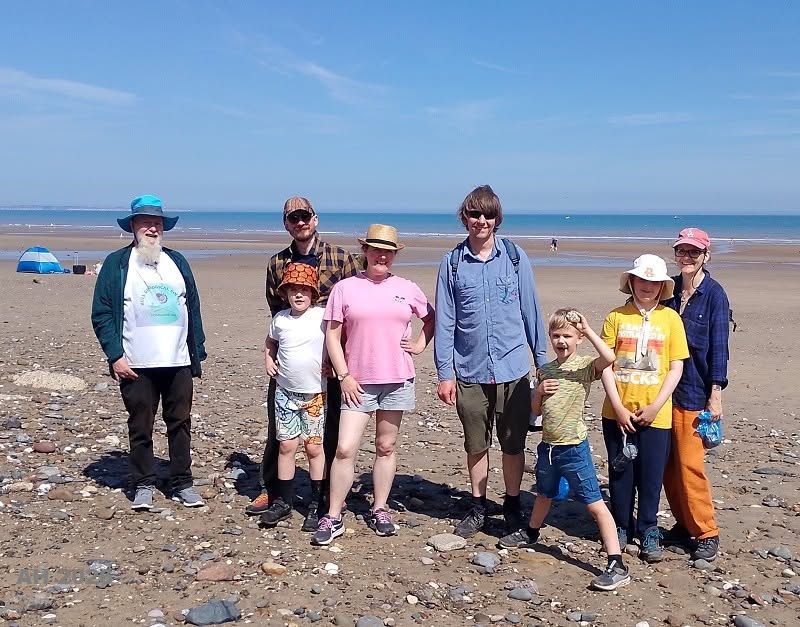
On Friday 14th August 2026 Brenda Almond and Mike
Horne led a party of three RockWatch families from Chesterfield, Sheffield and
Norwich to examine the cliffs of the Ice Age Coast at Skipsea Withow Mere in
East Yorkshire.
After meeting in the car park of Mr Moo’s Ice Cream Parlour
(and enjoying some ice creams) the party walked the footpath through the woods
and beside the fields to the cliff top to descend the low cliff to the beach.
Mike gave the party a simplified summary of the recent geological history of
Holderness illustrated by a map drawn in the beach sand. Before the ice ages the
coastline was a Chalk cliff along the eastern edge of the Yorkshire Wolds.
During the ice ages huge glaciers advanced into the area from the north,
bringing with them bits of rock from the Lake District, Northern England,
Scotland, Scandinavia and the bed of the North Sea. Vast amounts of Boulder Clay
were deposited which now forms the area known as Holderness in East Yorkshire.
This coastline composed of unconsolidated clay, silt, pebbles and boulders is
eroding rapidly, at an average of over 2m per year, with about 3.2 km of land
lost since Roman times. At Skipsea we can also examine the cross-section of a
freshwater lake (Skipsea Withow Mere SSSI) that formed behind a beaver dam (see
Marsters2011 for details).
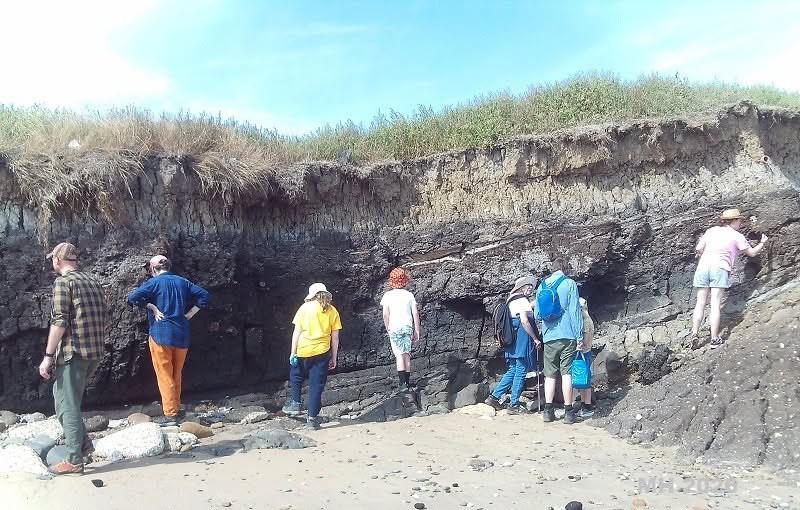
The party then examined the mere deposits which rest on a
depression in the boulder clay, consisting of a gravel (in places), followed by
a blue grey clay that contains abundant freshwater ostracods and gastropods.
Above this is a thick peat deposit that coarsens upwards to contain some large
tree branches near the top. Members of the party found hazelnuts in the peat
that could be 6000 or more years old. The section is capped by modern soil, and
field drainage pipes can be seen in places.
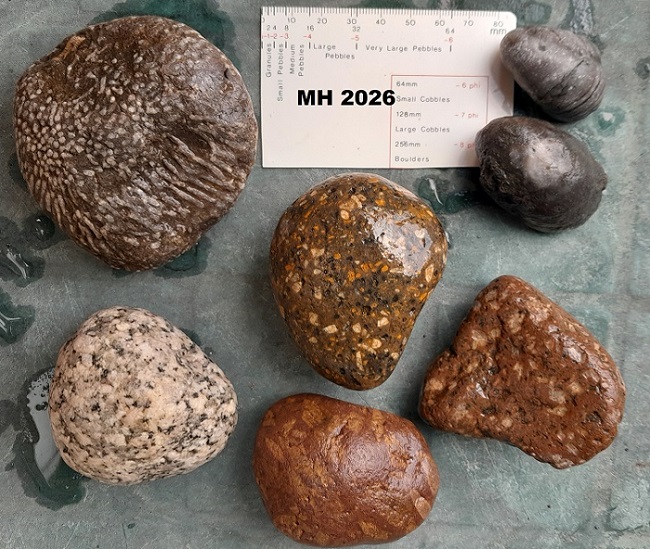
The party then searched the beach for interesting glacial
erratics that have washed out of the boulder clay cliffs. This site is the type
section for the Skipsea Till, the middle one of three Devensian-age boulder clay
deposits in Holderness. The rocks and fossils that were observed included:
Brockram from Cumbria, porphyries from Norway and the Cheviots, the Jurassic
oyster Gryphaea, Cretaceous
belemnites, corals in Carboniferous Limestone from the North Pennines and black
flint from the bed of the North Sea. Mike explained that the flints found in the
Chalk exposed in Yorkshire are pale grey in colour and shatter unpredictably if
you break them. The black flints are derived from younger Chalk which must have
been picked up by glaciers crossing the bed of the North Sea. Some exquisitely
preserved tiny pieces of crinoid stem were also found; it is amazing to consider
how they survived undamaged in a glacier that was carrying large boulders that
show the scars caused when they rubbed against each other.
References and further reading
Marsters T 2011. Skipsea Withow Mere.
Humberside Geologist 15.
https://www.hullgeolsoc.co.uk/hg1509.htm
Horne M 1999 onwards.
Welcome to the Ice Age Coast website -
https://www.hullgeolsoc.co.uk/holdhome.htm
Photos by Anne and Mike Horne.
[Note – the people taking part gave their consent to
RockWatch to be photographed]
[First submitted 29th August 2026; published 12th September 2022]
copyright Hull Geological Society 2026