Hull Geological Society
Erratics – the silent sentinels of Holderness.
What
the ice age did for Holderness.
Written by Stuart Jones FGS, Hull Geological Society.
Printed and published by R S Jones FGS, Kingston upon Hull.
First published 2011.
Copyright RS Jones 2011.
Edited
and republished by Mike Horne FGS, Hull Geological Society 2026
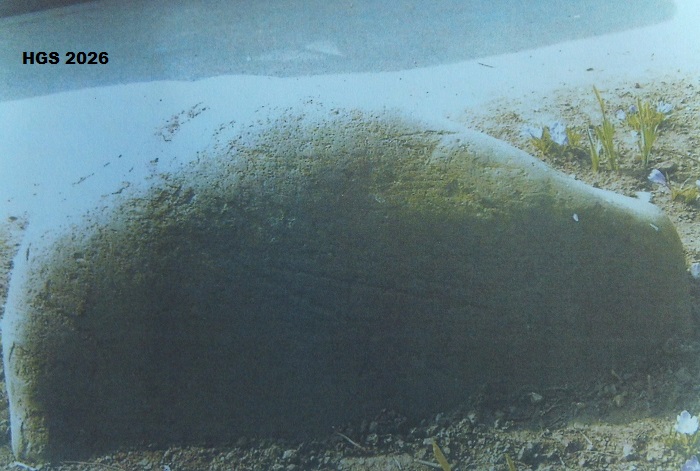
Front
cover: the Tesco Erratic, Southgate, Hornsea.
Introduction.
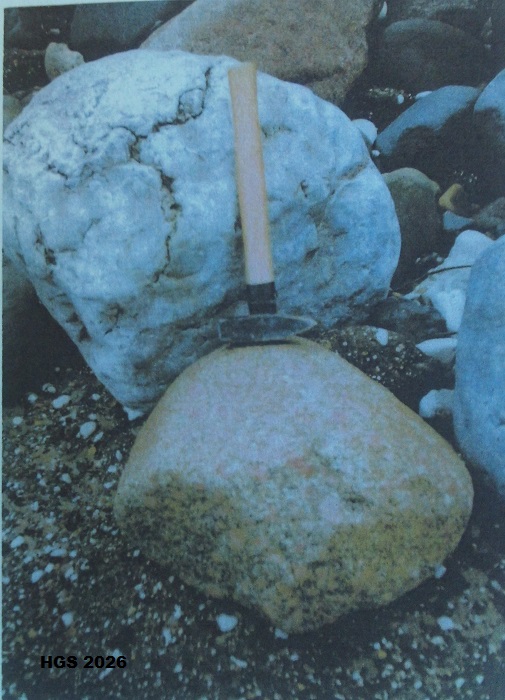
Walk along a beach in Holderness,
say Barmston, Skipsea, Hornsea, Mappleton or Aldborough and before long you will
come across some boulders of many shapes and sizes.
Look a little closer and it will be seen that
they are not all made of the same material.
There are some of limestone, some
are of granite, basalt or quartzite and many other different kinds of rock but
most of them will have one thing in common.
Look very closely and at least one side or face
will bear a series of parallel lines or grooves scratched into its surface.
This is a true sign that what you
are observing is an object known to geologists as an ‘erratic’ of glacial
origin.
These rocks have been transported to this place by
being trapped and frozen into the ice at the bottom of a glacier during the ice
age.
The grooves or striations are made by contact with
other stones and rocks over which the ice passed as it gradually spread over the
landscape.
What is not readily apparent is that
these erratics are not only to be found on the beaches where they have been
washed out of the cliffs by the sea’s constant erosion, but are also found
inland.
Maybe they are not so obvious as a good many have been
used for building material but the very large ones still survive and can be
found in the most unlikely of locations where they sit keeping their solitary
watch down the passing centuries.
This is their story.
At the end of the last period of
glaciations the landscape in the Holderness area and the surrounding parts of
the Yorkshire had taken on a somewhat different appearance to that which had
been in existence before the ice had engulfed it.
Much of the original topsoil had been scoured
away and subsoil together with the quantities of rock debris have been torn
loose and brought up to what is now the new surface level.
Some of this material
included very large boulders and of these there were some that have been carried
many miles from their place of origin by the ice as it advanced across the
landscape.
A large number of these rocks were
crushed and broken into smaller pieces and became buried and together with the
finer deposits of mud, silt etc.
They became part of the Boulder Clay of which
most of Holderness is formed, but a fairly significant quantity remained on or
close to the surface of the land.
As the years had
passed by some of these rocks sank under their own weight into the soil or clay
upon which they have been deposited as the ice cover melted and receded and yet
others of their kind remained at the surface level in places where the soil and
subsoil was of insufficient depth to allow them to become covered and survey
remained visible covered only by a thin cover of moss or lichens.
Our story concerns
some of these rocks that survived in today’s world in the locality of the town
of Hornsea on the coast of Holderness in the East Riding of Yorkshire.
Enquiries made
amongst the older citizens of this mini metropolis have produced the information
that in times past there were no less than four of these large erratic boulders
- one at each end of the four roads which enter the town and these were regarded
as ‘way markers’ or boundary stones.
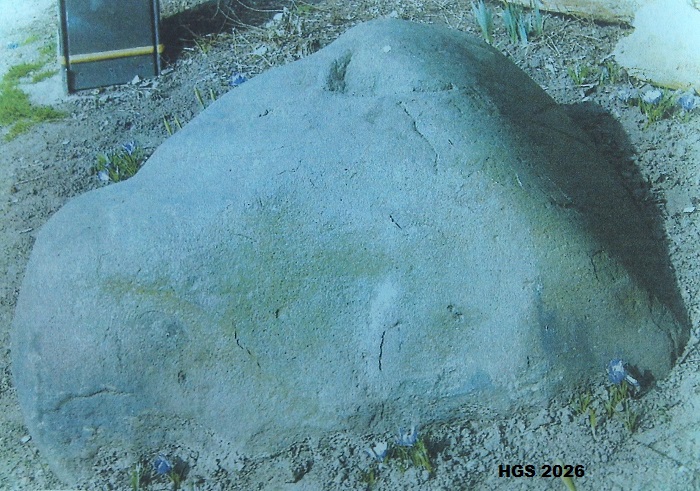
Unfortunately only one of these
rocks has survived into the 21st century more or less in the same
place as it had always been, on Southgate roundabout opposite the fire station
and near what was once a petrol station.
Adjacent to this site
is the new ‘Tesco’ building currently under construction and the contractors
have kindly undertaken to see that a place is made to display this last
remaining artefact at the entrance to the store car park.
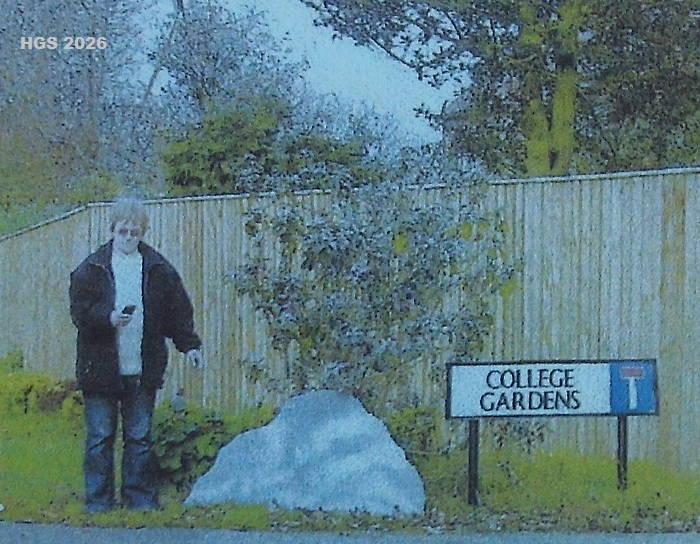
Another of the stones that was known
to the author in the early 1960s was at a place on Atwick Road (at the north
entrance to the town).
Their location is what is now the entrance to
College Gardens - a housing development which in the 1960s was a farmer’s field
used to store small fishing boats in the winter time when not in use.
The centuries and ages passed and in
the fullness of time new vegetation developed to clothe the barren landscape and
gradually the land became populated and an early form of cultivation began to
develop. As this
proceeded these great pieces of rocks (or some of them) came to the notice of
the people who worked the land etc.
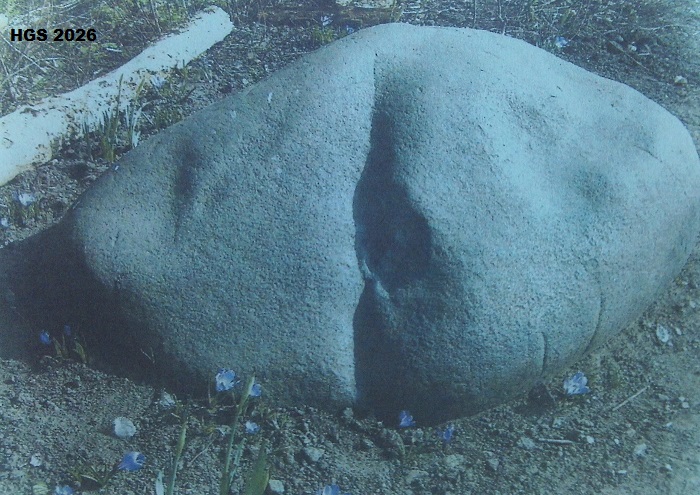
Also it is a fact that some of these
‘erratics’ - to give them the correct name, have proved to be so hard that they
would have easily defied the efforts of men with recourse only to basic and
towards and even the types of explosives available to the early engineers of the
15th century onwards.
Therefore they stayed where they were patiently
waiting as the centuries have passed them by until man had invented devices
capable of moving such objects.
By this time some of
these rocks have become surrounded by towns and indeed they can still be seen to
this day in quiet corners where the people have become quite used to their
presence and they are as familiar as lamp posts or pillar boxes - a sort of
natural street furniture.
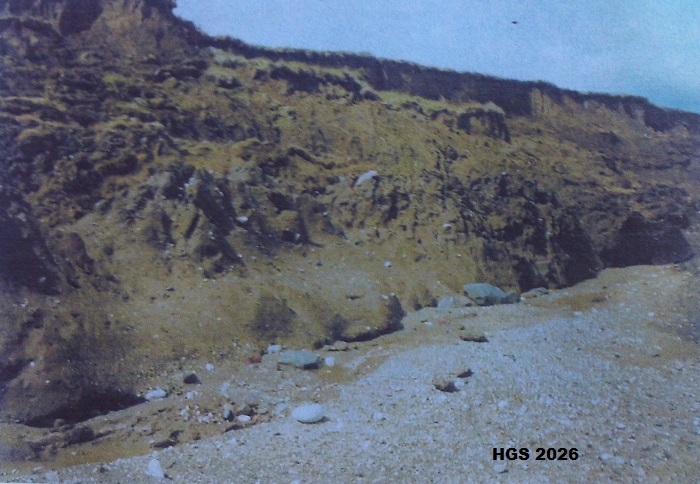
The cliffs at
Aldborough.
Showing
some of the larger boulders that have recently been eroded out of the cliffs by
the action of the sea, and one is visible just emerging halfway up the cliff
(centre of picture).
Copyright - Hull Geological Society 2026
Registered Educational Charity No. 229147