Hull Geological Society
What
the Ice Age did to Holderness.
Written by Stuart Jones FGS
Hull
Geological Society
Copyright R S Jones 2008
[Written to accompany a display of specimens
at the
Treasure House, Beverley]
[Re-edited by Mike Horne and re-published in 2026]
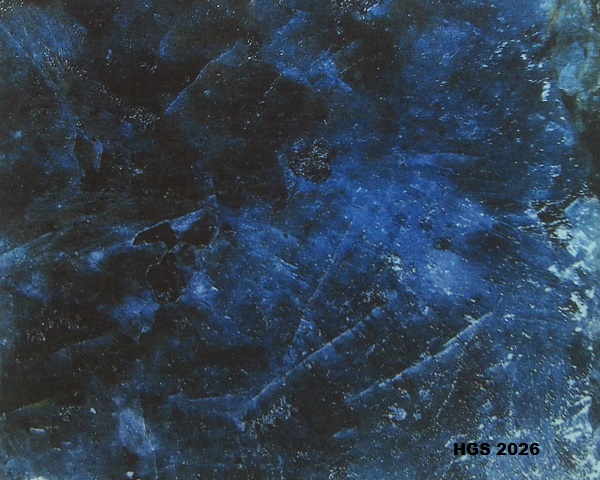
Polished Larvikite
The origins of
glacial erratics in Holderness.
The great ‘Ice Age’
began about 2 million years ago and the last period of glaciation came to an end
approximately 10 000 years ago. During this period of time the ice advanced
southwards over Britain on no fewer than four occasions. Each period of
glaciation began with a cooling of the climate when the winter lingered into
summer and a slow build-up of snow began on our mountains. Eventually the snow
was compacted into glacier ice and the glaciers were drawn off our northern
mountains to spread their icy fingers over the British scene. The ice sheets
were very destructive and their effect on the landscape was quite considerable.
They broke rocks away from existing rock faces. They also cleared away most of
the soil and rocks off the rock surfaces over which they passed. Slowly they
advanced over the countryside, generally in a southward direction. As they
proceeded so the rock debris they has collected travelled with them, away from
the area where they were originally created.
Ultimately the ice
reached a point on its journey southwards where the temperature was too warm for
it to exist and here its forward motion ceased. Eventually, with the onset of
warmer conditions the ice began to melt. This resulted in great columns of water
flowing out from under the ice. The water carried with it large quantities of
rock debris and deposited it over the surrounding country. In some cases the
rock debris was simply left behind as a monument to the passing of the ice. The
resulting debris is now called ‘boulder clay’. Boulder clay lives up to its
name! It consists of a dark brown or greyish clay with numerous pebbles and
rocks embedded in it. In some places on our east coast, the clay is present in
low cliffs which sit upon a harder bedrock. Cliffs of this type are especially
common in Yorkshire around Whitby, where they can be seen overlying the Jurassic
shales, south of Scarborough and on the long stretch of coast from Bridlington
to Spurn Point.
The Lincolnshire
coast also exhibits boulder clay cliffs and it can be found on the
Northumberland coast. Although the clay is highly tenacious particularly in the
way it sticks to your wellies, it is easily eroded by the action of the sea.
Naturally enough, this erosion only serves to release the pebbles it contains on
to the beaches where the tide quickly shuffles them amongst the other pebbles.
We have now seen a process by which the pebbles and rock fragments collected on
the hills to the north have been transported on to the nearby beach, in many
cases hundreds of miles from their places of origin. Our knowledge of ice
movement during the last glaciation is reasonably complete but the overall
picture is still confusing. The boulder clay on the east coast was mainly
derived from the north and west, but there is also an accumulation of debris
from ice of Scandinavian origin.
To picture the events
of this time, we must imagine ice from the highlands of Scotland pressing
southwards, but being directed eastwards by ice from the Scottish borders and
the presence of the Cheviot Hills. Ice from the south west of Scotland and the
Lake District was deflected eastwards between the Cheviots and the Pennines.
More Lake District ice was allowed to pass eastwards between the Durham and
Yorkshire Pennines and under normal circumstances the progression would have
been still further east.
Unfortunately the
situation was complicated by a huge wall of Scandinavian ice which was moving
west and was close to the position of our current east coast. One layer of ice
or another may have overcome the obstacle and continued on its way, but the
overall effect was to deflect the British ice southwards and along what is now
the east coast.
The boulder clay on
our coast today must be of a diverse character because pebbles of Lake District,
Scottish, Cheviot, and Scandinavian origin may all be found on the beaches.
These findings are based upon the position indication of rocks of specific types
which now known from other locations.
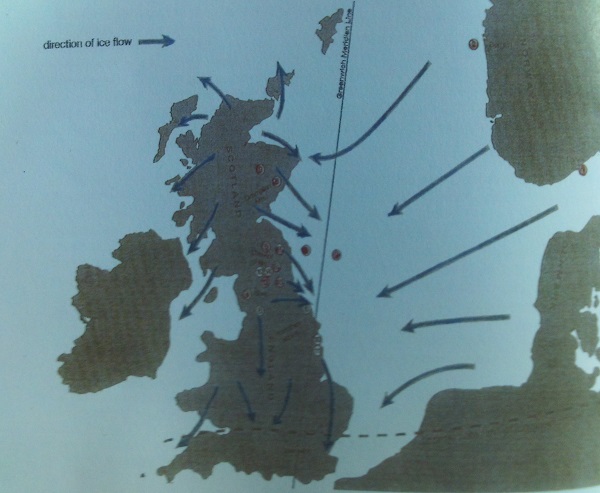
Map showing sources
of erratic rocks in the Holderness area.
1 Larvikite.
Larvikite is named after the town of Larvik in Norway near where it is quarried.
It is one of a group of medium to coarse grained intermediate intrusive igneous
rocks known as Syenites. Syenites are not common, the coarse grained varieties
are mainly restricted to intrusive bodies associated with granitic rocks.
Larvikite is commonly used as a facing stone on buildings. It is a course
grained blue-grey rock and when polished the feldspars within show a beautiful
play of light known as the Schiller Effect.
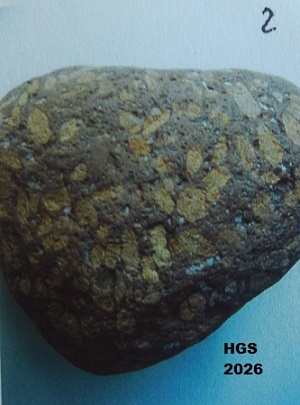
2 Porphyry (from the
Oslo area of Norway). Porphyry is an igneous rock showing large isolated
crystals in a much finer ground-mass. It originates as lava flows and vertical
intrusions known as Dykes.
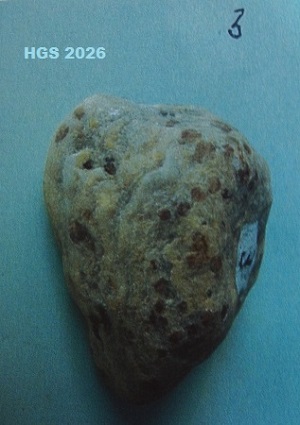
3 Garnet schist (from
the Cairngorm mountains in Scotland). Garnet schist is rich in micas, biotite
and muscovite, with quartz and feldspar also present. The usually well shaped
crystals of garnet are about 5mm in diameter and have grown in the rock during
the pressure and temperature changes [during metamorphism].
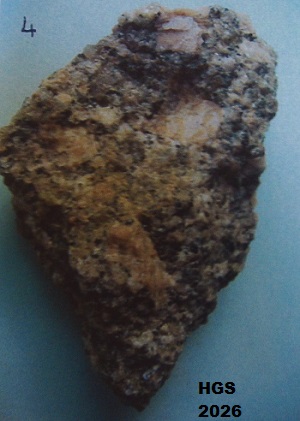
4 Shap Granite (from
Cumbria). A granite from Shap Fell in Cumbria, characterised by its large
porphyritic crystals of orthoclase [feldspar].
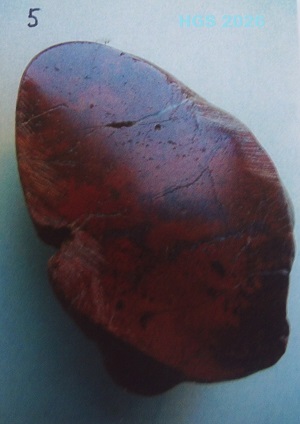
5 Red jasper (from
the Cheviot Hills). An opaque variety of silica, usually dull red, but sometimes
brown or yellowish-green. It derives its colour from various salts of iron and
its opacity is due to the clay inclusions amongst the quartz grains.
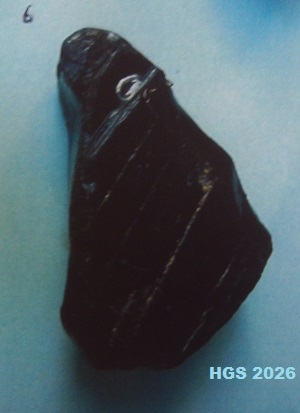
6 Jet (Whitby area,
Yorkshire). Jet is a very close relative of coal, especially of Lignite (wood
coal) and is derived from a tree known as the Araucaria Pine, or Monkey Puzzle
Tree as it is commonly called in today’s terminology. It is harder than coal and
takes a good polish making it ideal material for ornaments and jewellery for
which it has been used since Bronze Age times.
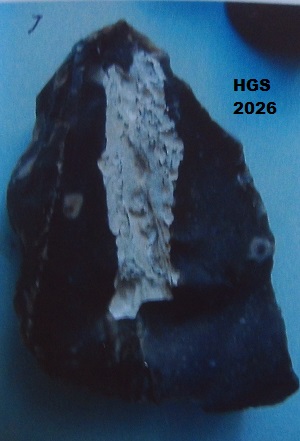
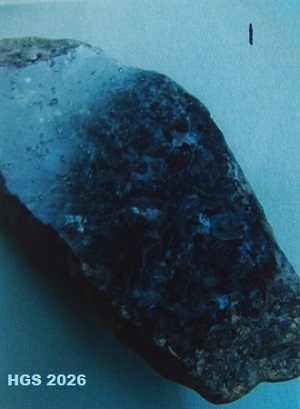
7 Black flint
[containing a fossil sponge]. The Chalk in Yorkshire contains flint of various
colours: brown, red, white, grey, yellow etc. but not black. The black flint we
find on Yorkshire beaches is that which is washed ashore from the bed of the
North Sea. Flint consists mainly of silica and the colouring comes from various
mineral salts and iron etc. absorbed before it was completely solidified. It is
extremely hard and breaks leaving a sharp edged fracture and has been used for
tools and weapons since prehistoric times.
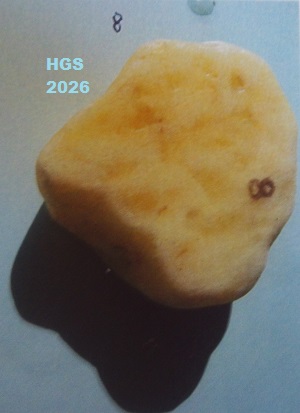
8 [Yellow] quartz.
Quartz is the commonest mineral in the earth’s crust and is found in all but the
basic and ultra-basic [igneous] rocks. Quartzites and sandstones consist almost
entirely of quartz. Despite the abundance of this mineral some varieties are
valued as semi-precious stones e.g. Citrine and Amethyst.
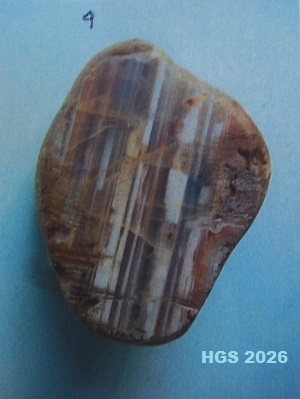
9 Banded agate (from
Scotland). Agates came into existence in the cavities of igneous rocks in much
the same way as flint is formed in the hollows of chalk – that is by the
solidifying of liquid silica in the cavities. However, in the case of agate the
solution of liquid silica did not fill the cavity and then solidify. There
appears to have been several stages in the process separated by intervals of
time. It is this that accounts for the difference of the colouring of the layers
or bands. The first solution that poured into the cavity may have been of pure
silica, which solidified into colourless quartz and he second may have contained
a chemical which coloured it and so on. The effect of this process is most
charmingly revealed on the cut and polished surface of a banded agate pebble.
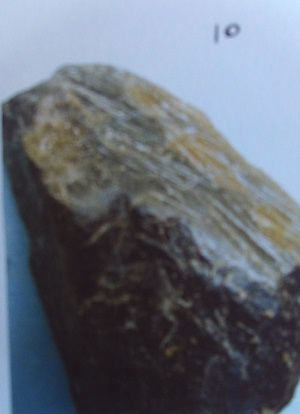
10 Ice scratched rock
[Carboniferous Limestone] (from the boulder clay deposits of Holderness). Rocks
and boulders are commonly found showing grooves and scratches which have been
caused by their passage over the frozen bedrock and ground whilst being frozen
into the ice of glaciers. Sometimes more than one set of lines is apparent.
Showing evidence of a change in direction or possibly re-transportation in a
later period of glaciation.
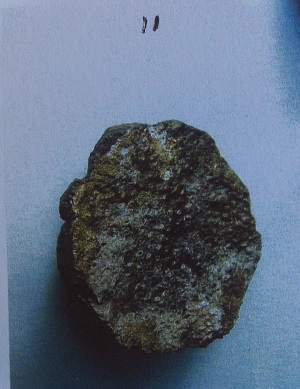
11 Pyrite nodule with
fossil [sponge]. Pyrite nodules are not uncommon in Chalk deposits, but not all
[of them] contain a fossil. In the specimen on display the nodule has most
likely been formed around a fossil and then grown larger over time while
surrounded by the chalk deposit.
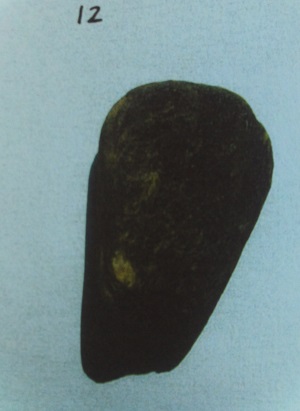
12 Carboniferous
Limestone (from the Northern Pennine area). This type of limestone originates
from deposits former during the Carboniferous period, some 270 to 350 million
years ago. It contains fossils and the dark colouration can vary from grey to
black. Specimens from the Holderness boulder clays are usually small pebble
size, but occasionally large boulders of 1 metre diameter or larger occur.
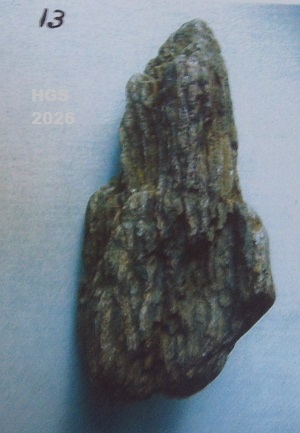
13 Lithostrotian
(Carboniferous coral). This is a type of coral that lived during the
Carboniferous and this particular form is from the Birtley area, south east of
Bellingham in Northumbria.
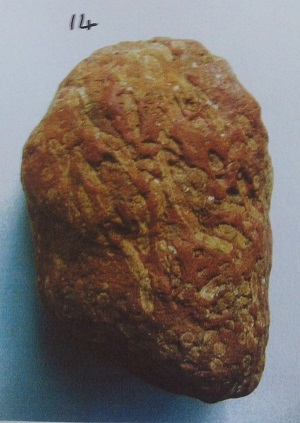
14 Red
Lithostrotian [Carboniferous coral]. This is also from the Carboniferous
period, but originates from the northern part of the Pennines. The red
colouration is due to the presence of mineral salts and iron oxide etc.
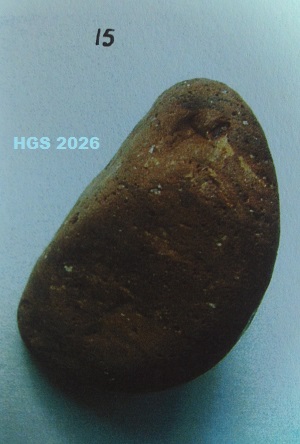
15 [Flow banded]
Rhyolite. This is a fine grained acid igneous rock. Rhyolites can be coloured
white, grey, pale green, red or brown. They are very fine grained rocks, but
sometimes they contain larger crystals (phenocrysts) and then they are called
‘porphyritic rhyolites’. These larger crystals are randomly arranged but they
may be confined to specific bands within the rhyolite and can be aligned. In
this case the phenocrysts have crystallised before the lava completely
solidified and the subsequent flow of the lava cause them to become aligned.
[Editor's note - the images are digital photographs of the original 2009 printed publication.]
Copyright - Hull Geological Society 2026
Registered Educational Charity No. 229147